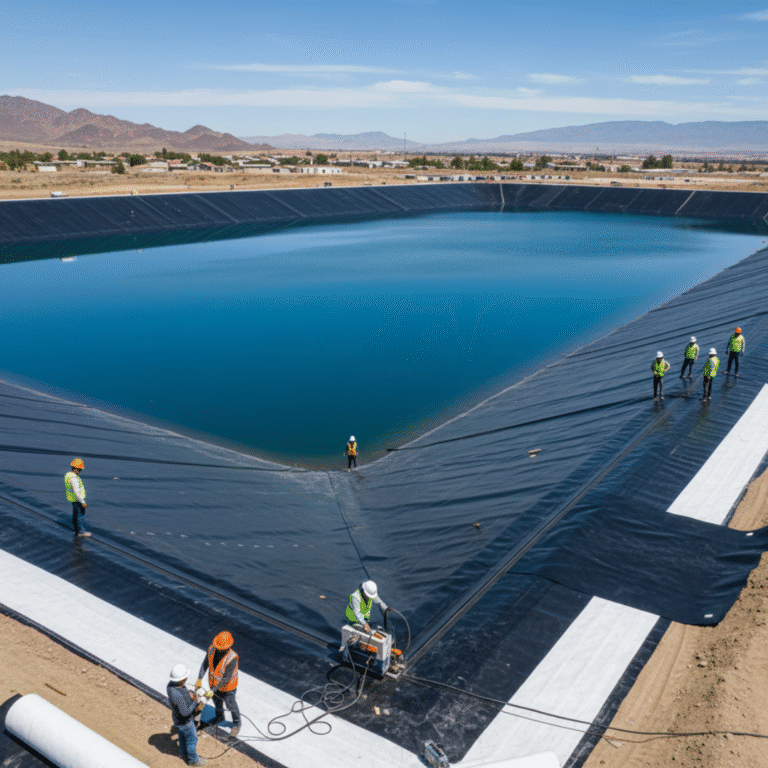

PVC Geomembrane Sheet
Geomembranes are an indispensable component in modern civil engineering and environmental protection, acting as robust, impermeable barriers to prevent fluid migration. Among the various types, the PVC geomembrane sheet stands out for its unique blend of flexibility, durability, and cost-effectiveness. This blog post explores everything you need to know about this popular geosynthetic material, from its key characteristics to its real-world applications and limitations.
What is a PVC Geomembrane Sheet?

A PVC geomembrane sheet is a flexible, waterproof lining material primarily composed of Polyvinyl Chloride (PVC) resin. The raw PVC polymer is inherently rigid, but manufacturers introduce specialized additives and plasticizers (1) to transform it into the highly flexible, large-format sheeting required for lining and containment projects. These sheets are a type of geomembrane liner used across a wide range of industries to create an effective seal against liquids and gases.
Note: Plasticizers are crucial in achieving the desired flexibility but can sometimes be a point of discussion regarding material longevity and chemical resistance.
Key Features of PVC Geomembrane Sheets
The properties of the Polyvinyl Chloride (PVC) formulation are what define this product. Here are the standout features that make it a go-to choice:

1. Exceptional Flexibility and Elongation
This is arguably the most desirable property. Unlike stiff membranes like HDPE, PVC geomembranes are highly flexible and elastic. They can conform easily to irregular subgrades, including complex contours and trenches, reducing the need for extensive site preparation. This high flexibility translates to a very high elongation at break, which means the material can stretch significantly—up to 300% or more—before failure.
2. Superior Seam Strength
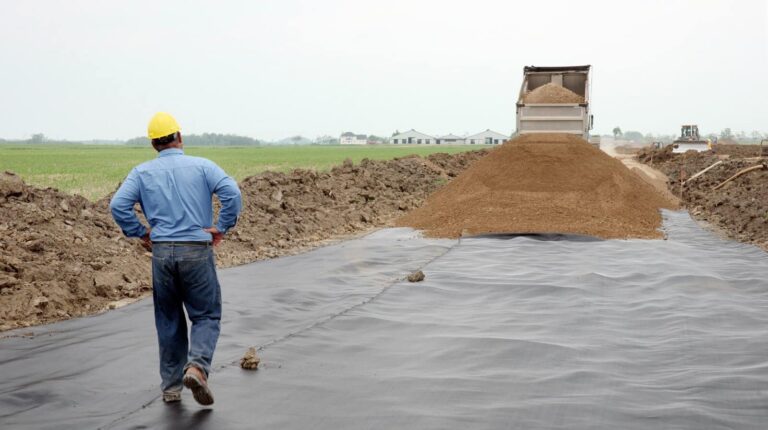
PVC geomembranes are easily seamed in the field using heat-welding or, in many cases, chemical bonding techniques. This ease of welding is a major advantage, allowing for the creation of extremely large, continuous panels with seams that are often as strong as the original material. This reduces the number of field seams required compared to other liners.
3. Low Permeability
As a containment barrier, the PVC geomembrane offers very low permeability, effectively preventing the seepage of water, wastewater, or other liquids into the subgrade. This makes it a dependable barrier in both environmental and industrial applications.
4. Durability and Puncture Resistance
PVC is known for its inherent toughness. The membrane’s elastic nature gives it good puncture resistance, as it can absorb and deflect localized stresses without tearing abruptly. It also possesses a long service life, often exceeding 10-20 years in standard buried conditions.
5. Chemical and UV Resistance (with Additives)
The sheet offers good resistance to a variety of chemicals, acids, and bases, making it suitable for many industrial effluents. While raw PVC has poor resistance to ultraviolet (UV) light, the geomembrane formulation includes UV stabilizers and pigments to provide the necessary protection for exposed applications.
PVC Geomembrane Pros and Cons
Choosing the right geomembrane material is crucial for project success. Here is a balanced look at the advantages and disadvantages of using a PVC liner:
Advantages (Pros)
| Advantage | Description |
| Ease of Installation | High flexibility allows the material to drape over subgrades easily, speeding up installation and reducing labor costs. Large pre-fabricated panels (up to 40,000 sq ft) also minimize field welding. |
| Excellent Flexibility | Conforms perfectly to complex and uneven surfaces, making it ideal for decorative ponds, canals, and secondary containment areas with irregular shapes. |
| Cost-Effective | Compared to other synthetic liners like FPA (Flexible Polymer Alloy) or certain HDPE (High-Density Polyethylene) grades, the PVC geomembrane is often a more economical solution for many containment applications. |
| High Tear Resistance | The material’s high elongation property allows it to stretch substantially when stressed, making it resilient against tears and punctures from sharp objects in the underlying soil. |
| Superior Frictional Performance | Smooth PVC geomembranes provide higher residual friction angles than smooth HDPE, offering better stability on steeper slopes. |
Disadvantages (Cons)
| Disadvantage | Description |
| Plasticizer Migration | Over very long periods, particularly in high-temperature or exposure to certain organic liquids/solvents, the plasticizers can leach out, which can cause the liner to stiffen and become brittle over time. |
| Temperature Sensitivity | PVC can become slightly more brittle in very cold temperatures, which needs to be managed during installation in freezing climates. It may also soften at very high continuous operating temperatures compared to crystalline liners. |
| Chemical Limitations | While generally resistant, PVC is not suitable for all aggressive chemicals, particularly strong solvents or hydrocarbons, which can dissolve or extract the plasticizers. HDPE geomembrane may be preferred for these applications. |
| Environmental Concerns | The production and disposal of PVC as a non-biodegradable material raise some environmental protection concerns, though its long service life and pollution prevention capabilities are a counter-benefit. |
Common Applications of PVC Geomembrane Liners
The versatility and favorable properties of the PVC geomembrane liner make it suitable for numerous civil and environmental engineering projects:

- Water Management and Conservation: Used extensively as pond liners for ornamental lakes, golf course water features, and agricultural reservoirs/canals for water containment and irrigation.
Waste Management: Employed in landfill caps and closure systems to control the migration of precipitation and gases.
Industrial Containment: Forms the barrier in secondary containment systems for chemical and fuel storage tanks to prevent accidental spills from reaching the soil or groundwater.
Wastewater Treatment: Lining of treatment lagoons and retention ponds in wastewater treatment plants.
Mining Operations: Used in heap leach pads, tailings impoundments, and process water ponds.
Tunnels and Basements: Applied as a waterproofing layer in underground structures and foundations.
Conclusion: Is a PVC Geomembrane Right for Your Project?
The PVC geomembrane sheet offers a compelling combination of flexibility, cost-effectiveness, and reliable performance. Its ease of fabrication into large panels and its capacity to conform to complex shapes make it a superior choice for projects where the subgrade is uneven or installation time is a critical factor.
While other materials like HDPE or LLDPE (Linear Low-Density Polyethylene) may be better suited for highly aggressive chemical environments or continuous extreme temperatures, for the vast majority of water containment and standard environmental barrier applications, PVC geomembranes provide a robust, durable, and economically sound solution. Always consult with an experienced geosynthetics specialist to choose the correct material, thickness, and formulation—such as reinforced PVC geomembrane—to meet the specific demands of your site and longevity requirements.
FAQ’S
What is a PVC geomembrane sheet used for?
PVC geomembrane sheets are used for pond lining, aquaculture farms, water storage tanks, canals, landfills, wastewater treatment, and industrial containment applications due to their flexibility and waterproof properties.
How is PVC geomembrane different from HDPE geomembrane?
PVC geomembrane is more flexible, easier to install, and performs better in complex or curved surfaces, while HDPE is stronger, more chemical-resistant, and suitable for large-scale containment. PVC is ideal for smaller, irregular ponds and tanks.
What thickness of PVC geomembrane is commonly used?
PVC geomembrane sheets are commonly available in 0.5mm, 0.75mm, 1.0mm, and 1.5mm thicknesses, depending on the project requirements for durability, water pressure, and environmental conditions.
Is PVC geomembrane safe for fish farming ponds?
Yes. PVC geomembranes are non-toxic, flexible, and waterproof, making them suitable for aquaculture ponds, fish tanks, and shrimp farms. They help maintain stable water quality and prevent seepage.
Do suppliers in Pakistan offer installation services for PVC geomembranes?
Many suppliers provide complete services, including material supply, on-site installation, panel deployment, welding, seam testing, and quality assurance to ensure long-term performance and leak protection.