
Geo Membrane for Chemical Industry: Acid-Resistant Liners
The chemical industry, by its very nature, deals with corrosive and often hazardous substances. From production facilities and storage tanks to wastewater treatment ponds and secondary containment areas, the risk of chemical spills and leakage is a constant concern. This is where geo membranes for the chemical industry become indispensable, particularly specialized acid-resistant liners. These advanced containment solutions are crucial for preventing environmental contamination, ensuring worker safety, and maintaining operational integrity in environments where aggressive chemicals are present.
The Challenge of Chemical Containment
Chemical facilities face unique challenges regarding containment:

Corrosive Substances: Many industrial chemicals, including strong acids and bases, can rapidly degrade conventional lining materials, leading to failures and leaks.
Environmental Regulations: Strict environmental protection regulations mandate robust containment systems to prevent soil and groundwater contamination, imposing heavy penalties for non-compliance.
Safety Hazards: Leaking chemicals pose direct threats to personnel, potentially causing burns, respiratory issues, or other serious health problems.
Operational Downtime: Containment failures result in costly cleanup operations, production halts, and damage to reputation.
To mitigate these risks, the selection of the correct geomembrane material with superior chemical resistance is paramount.
What Makes a Geomembrane “Acid-Resistant”?
An acid-resistant liner is a type of geomembrane specifically formulated and engineered to withstand prolonged exposure to aggressive chemical environments, particularly those with low pH values (acids) or high pH values (bases). This resistance is achieved through:
Polymer Type: The base polymer itself must be inherently resistant.
Additives and Stabilizers: Specific formulations include additives to enhance chemical resistance, UV stability, and long-term durability.
Manufacturing Process: High-quality manufacturing ensures a consistent, defect-free sheet with optimal molecular structure.
The goal is to prevent the chemical from degrading the liner’s physical properties (e.g., embrittlement, softening, cracking) or permeating through it.
Key Geomembrane Materials for Acid Resistance

While many geomembranes exist, certain types are preferred in the chemical industry due to their superior resistance to acids and other harsh chemicals:
1. HDPE (High-Density Polyethylene) Geomembrane
HDPE geomembranes are the workhorse of the chemical containment industry. Their key advantages include: * Excellent Chemical Resistance: Highly resistant to a broad spectrum of acids, alkalis, salts, and many organic compounds. This is why HDPE is frequently chosen as an acid-resistant geomembrane. * High Strength and Durability: Offers exceptional tensile strength, tear resistance, and puncture resistance, crucial for long-term performance under stress. * UV Resistance: With carbon black and other stabilizers, HDPE performs well in exposed applications. * Thermal Fusion Seaming: HDPE panels are heat-welded together, creating seams that are often stronger than the parent material, ensuring a continuous, impermeable barrier.
2. FPP (Flexible Polypropylene) Geomembrane
FPP geomembranes, also known as polypropylene geomembranes, offer excellent chemical resistance, particularly to a wide range of organic compounds and strong acids. They are more flexible than HDPE, which can be an advantage in certain installations.
3. Specialty Elastomeric Geomembranes
For the most aggressive chemical environments, highly specialized elastomeric geomembranes like XR-5® (a proprietary blend of high-strength fabric and polymer coatings) are used. These liners are engineered for extreme conditions, offering unparalleled resistance to a vast array of industrial chemicals, including concentrated acids, fuels, and hazardous waste streams. They are often referred to as chemically resistant liners due to their robust formulation.
4. PVC (Polyvinyl Chloride) (with caveats)
While standard PVC geomembranes are flexible and have good general chemical resistance, they are generally not recommended for strong acid or solvent exposure due to potential plasticizer extraction, which can lead to embrittlement. However, specially formulated, reinforced PVC options might be considered for milder chemical applications where flexibility is paramount.
Applications of Acid-Resistant Liners in the Chemical Industry

Acid-resistant liners are deployed in a variety of critical applications across the chemical sector:
Process Ponds and Lagoons: Lining ponds that hold acidic or alkaline wastewater from manufacturing processes.
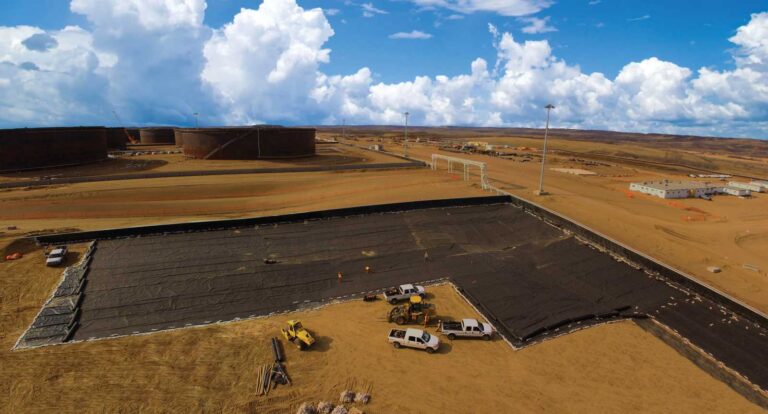
Secondary Containment: Creating impermeable barriers around chemical storage tanks, drums, and reactors to prevent spills from reaching the environment. This is a primary requirement for hazardous waste management.
Brine Ponds: Used in industries like mining and desalination for containing highly concentrated salt solutions, which can be corrosive.
Tank Liners: In some cases, geomembranes can be fabricated to line internal surfaces of concrete tanks for enhanced chemical resistance.
Evaporation Ponds: Containing and evaporating chemical process water or runoff.
Landfill Cells for Industrial Waste: Lining dedicated landfill cells for the disposal of chemically aggressive industrial waste, often requiring multi-layered composite liners (1) for maximum security.
Note: Composite liners combine a geomembrane with a compacted clay layer or geosynthetic clay liner (GCL) for redundant protection.
Design and Installation Considerations
The effectiveness of geo membranes for the chemical industry goes beyond material selection. Proper design and liner installation are equally critical:
Subgrade Preparation: The subgrade must be smooth, stable, and free of sharp objects to prevent liner damage. A protective geotextile is often used beneath the geomembrane.
Seam Integrity: For welded liners like HDPE, ensuring high-quality, continuous seams is paramount. Poor seams are common points of failure.
Anchoring and Penetrations: Proper anchoring of the liner and meticulous detailing around pipes, sumps, and other penetrations are essential to prevent leaks.
Testing: Non-destructive and destructive testing of seams and the overall liner system is crucial to verify integrity before commissioning.
Long-Term Compatibility: Consulting with material specialists and performing chemical compatibility testing for specific effluents is always recommended to ensure the chosen geomembrane will withstand the anticipated chemical exposure over its design life.
Conclusion
The use of advanced geo membranes for the chemical industry, particularly acid-resistant liners, is no longer an option but a necessity. These specialized containment solutions provide the critical barrier needed to protect soil, groundwater, and personnel from the hazards of aggressive chemicals. By investing in the right geomembrane material and adhering to rigorous design and liner installation practices, chemical facilities can operate safely, comply with stringent environmental protection regulations, and uphold their commitment to hazardous waste management and environmental stewardship. The judicious selection of a robust, chemically resistant liner is truly the foundation for secure and responsible chemical operations.
FAQ’S
Why are geomembranes used in the chemical industry?
Geomembranes provide a durable, impermeable barrier that protects soil and groundwater from chemical leaks, hazardous spills, and industrial effluents. They are essential for chemical storage tanks, ponds, lagoons, and wastewater containment.
Which type of geomembrane is best for chemical applications?
HDPE geomembranes are widely preferred because they are highly chemical-resistant, UV-stable, puncture-resistant, and durable. LDPE can be used for low-stress applications, but HDPE is ideal for most industrial chemical containment needs.
What thickness of geomembrane is recommended for chemical containment?
For chemical industry applications, geomembrane thickness typically ranges from 1.5mm to 2.5mm or more, depending on the type of chemicals, storage pressure, and regulatory requirements. Thicker liners provide better mechanical strength and long-term reliability.
Can geomembranes withstand hazardous or corrosive chemicals?
Yes. HDPE and specially formulated chemical-resistant geomembranes are designed to resist acids, alkalis, fuels, oils, and other hazardous substances, making them safe for industrial ponds, chemical tanks, and effluent containment systems.