
Geomembranes for Landfill Protection: How It Works?
Landfills are essential facilities for managing the vast amounts of waste generated by modern societies. However, without proper engineering, they can pose significant threats to the environment, particularly through the contamination of soil and groundwater. This is where geomembranes for landfill protection become absolutely critical. These robust, impermeable barriers are the frontline defense in preventing hazardous substances from escaping waste containment areas, ensuring long-term environmental safety.
The Challenge of Landfill Containment
Modern landfills are not just open pits; they are highly engineered structures designed to minimize environmental impact. The primary challenges in landfill management include

Leachate Generation: As precipitation infiltrates the waste mass, it percolates through the decaying materials, dissolving various contaminants and forming a highly toxic liquid known as leachate (1). This leachate can contain heavy metals, organic pollutants, and pathogens.
Gas Emissions: Decomposition of organic waste generates significant quantities of landfill gas (2), primarily methane and carbon dioxide, which are potent greenhouse gases and can pose explosion risks.
Groundwater Contamination: Without an effective barrier, leachate can migrate into underlying soil layers and ultimately contaminate precious groundwater resources, impacting drinking water supplies and ecosystems.
Note: Managing leachate is one of the most complex aspects of landfill operations, requiring sophisticated collection and treatment systems. (2) Note: Landfill gas is often captured and converted into energy, but preventing its uncontrolled release is paramount.
What is a Geomembrane in Landfills?
A geomembrane is a synthetic, low-permeability liner used in civil engineering projects, primarily for containment. In the context of landfills, it acts as an impervious barrier to prevent the migration of liquids and gases. These liners are typically made from various polymeric materials, with HDPE geomembrane (High-Density Polyethylene) being the most common choice due to its excellent chemical resistance and durability.
The role of a geomembrane liner in a landfill system is multi-faceted, forming an integral part of both the base lining system and the final cap.
How Geomembranes Work in Landfill Base Liners?
The base liner system is perhaps the most critical component of landfill protection. It is designed to prevent leachate from ever reaching the underlying soil and groundwater. Here’s how geomembranes function in this crucial role:


1. Primary Containment Barrier
At the heart of the base liner is at least one, and often multiple, layers of geomembrane. This layer creates an almost impenetrable barrier, preventing the downward flow of leachate. Modern landfill designs often feature a double composite liner system, which includes: * Primary Geomembrane: The uppermost geomembrane directly beneath the waste. * Geonet or Drainage Layer: A granular or synthetic drainage layer (often a geocomposite drain) placed directly above the primary geomembrane to collect and transport leachate to collection pipes. * Secondary Geomembrane: A second geomembrane beneath the drainage layer, acting as a redundant barrier. * Leak Detection System: Typically a drainage layer between the primary and secondary geomembranes, designed to detect and collect any leachate that might pass through the primary liner, signaling a potential breach. * Compacted Clay Layer (CCL): Often, a layer of natural low-permeability soil is placed beneath the secondary geomembrane, providing an additional hydraulic barrier.
This multi-layered approach ensures robust waste containment and maximizes the chances of intercepting any leachate before it can escape.
2. Chemical Resistance
Landfill leachate is a complex cocktail of chemicals. Geomembranes, especially HDPE, are specifically engineered to resist degradation from a wide range of organic and inorganic compounds found in leachate. This chemical inertness is vital for the liner’s long-term integrity and effectiveness.
3. Strength and Durability
Geomembranes must withstand the immense pressure of tons of waste, as well as stresses from equipment and differential settlement. Their high tensile strength and puncture resistance ensure they maintain their barrier function under challenging conditions over decades.
How Geomembranes Work in Landfill Caps (Closure Systems)
Once a landfill cell reaches its capacity, it must be closed down to prevent further environmental impact. This is achieved by installing a final cover system, or “cap,” which also heavily relies on geomembranes. The landfill cap’s functions are:
1. Precipitation Barrier
The most important role of the geomembrane in a cap is to prevent rainwater from infiltrating the waste mass. By drastically reducing infiltration rates, it minimizes the generation of new leachate, which in turn reduces the burden on the leachate treatment system. This is a critical aspect of environmental protection.
2. Landfill Gas Containment
The geomembrane layer in the cap also acts as a barrier to contain landfill gas. This helps in two ways: * It prevents uncontrolled atmospheric release of methane (a potent greenhouse gas). * It facilitates the efficient collection of landfill gas for flaring or energy recovery.
3. Erosion Control
While the geomembrane itself is buried, it forms the impermeable layer that supports overlying soil layers. These soil layers, often vegetated, are essential for erosion control, preventing the topsoil from being washed away and exposing the underlying waste.
A typical landfill cap often includes: * Geomembrane: The primary barrier layer. * Geotextile: A protective fabric placed above and/or below the geomembrane to prevent punctures. * Drainage Layer: A layer of granular soil or a geocomposite drain to shed water off the geomembrane. * Protective Soil Layer: A thick layer of soil to protect the geomembrane from UV, physical damage, and root intrusion. * Vegetation Layer: Topsoil and vegetation for erosion control and aesthetics.
Types of Geomembranes Used in Landfills
While HDPE is dominant, other types of geomembrane material are also used:
HDPE (High-Density Polyethylene): Most common due to excellent chemical resistance, high strength, and good UV resistance. Ideal for large, long-term containment.
LLDPE (Linear Low-Density Polyethylene): More flexible than HDPE, making it easier to install in complex geometries and less prone to stress cracking.
PVC (Polyvinyl Chloride): Highly flexible, often used for smaller, more intricate areas or where conformability is paramount, though it has different chemical resistance profiles than HDPE.
The choice of material depends on factors such as leachate composition, site specific conditions, installation techniques, and project budget.
Conclusion
Geomembranes for landfill protection are fundamental to modern waste management strategies. By acting as robust, impermeable barriers in both base liners and final caps, they effectively contain hazardous leachate and landfill gas, preventing contamination of soil and groundwater. The meticulous design and installation of these synthetic liners are paramount, requiring expert knowledge in geosynthetics to ensure the long-term environmental integrity of these critical facilities. Without them, our landfills would pose an unmanageable risk to public health and the environment, highlighting their indispensable role in safeguarding our planet.
FAQ’S
Why are geomembranes used in landfill protection?
Geomembranes are used in landfills to prevent leachate leakage, protect soil and groundwater, and act as a reliable impermeable barrier. They keep hazardous waste contained and comply with environmental protection standards.
What type of geomembrane is best for landfill applications?
HDPE geomembrane is the most widely used for landfill liners due to its high chemical resistance, UV stability, puncture strength, and long lifespan. It performs well under extreme loads and harsh environmental conditions.
What thickness is recommended for landfill geomembrane liners?
Landfill applications typically use 1.5mm, 2.0mm, and even 2.5mm HDPE geomembrane depending on the waste type, pressure, environmental regulations, and design requirements. Thicker liners offer better durability and leakage protection.
How is geomembrane installed in landfill projects?
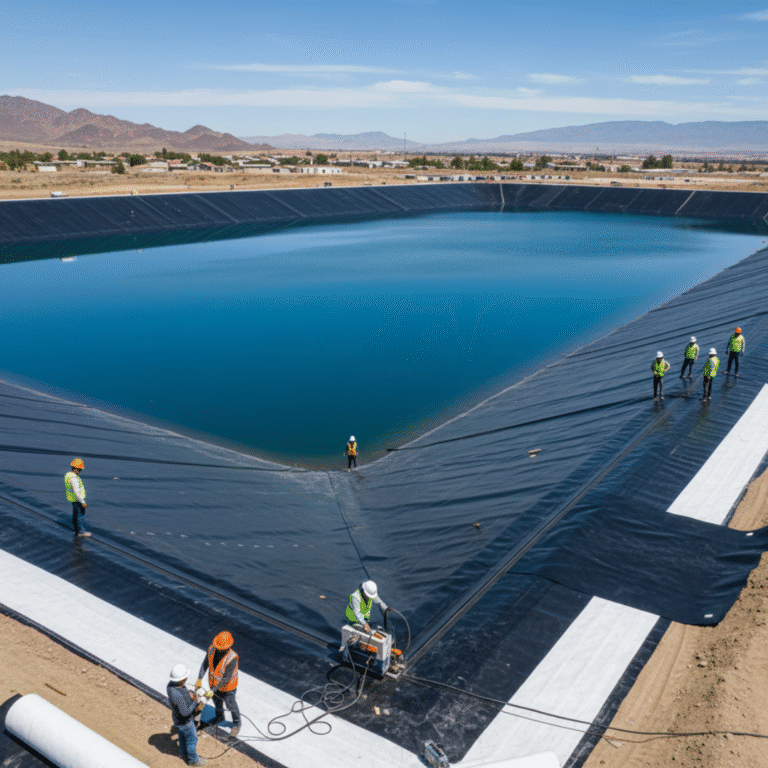
Geomembranes are installed through site preparation, subgrade leveling, panel deployment, hot wedge or extrusion welding, and thorough seam testing. Quality control (QC) and quality assurance (QA) are essential to ensure a leak-free and long-lasting liner system.
Can geomembrane liners resist chemicals and heavy loads in landfills?
Yes. HDPE geomembranes are engineered to resist chemicals, acids, leachate, gases, and high mechanical loads, making them suitable for municipal, industrial, and hazardous waste landfills.