
Industrial Geomembrane Applications in Pakistan
Pakistan’s industrial sector is rapidly expanding, bringing with it both economic growth and increasing environmental challenges. From managing industrial wastewater to securing valuable resources, the need for robust and sustainable engineering solutions is paramount. Industrial geomembrane applications are emerging as a critical tool in this context, offering unparalleled containment, protection, and operational efficiency across a diverse range of industries. These high-performance synthetic liners are transforming how industries in Pakistan handle liquids and solids, ensuring compliance, preventing contamination, and fostering environmental stewardship.
The Crucial Role of Geomembranes in Pakistan’s Industrial Landscape

Geomembranes are essentially impermeable synthetic barriers, typically made from polymers like High-Density Polyethylene (HDPE) or Linear Low-Density Polyethylene (LLDPE). Their primary function is to contain liquids, solids, or gases, preventing their migration into or out of a designated area. In Pakistan’s industrial environment, geomembranes provide solutions for:
Environmental Protection: Preventing soil and groundwater contamination from industrial waste.
Resource Conservation: Minimizing water loss in industrial ponds and reservoirs.
Safety Compliance: Meeting national and international environmental regulations.
Infrastructure Durability: Extending the life of industrial facilities by protecting foundations and structures.
Cost-Effectiveness: Reducing long-term operational costs associated with seepage and maintenance.
Key Industrial Geomembrane Applications Across Pakistan
The versatility of geomembrane technology allows for its integration into numerous industrial processes.

1. Wastewater Treatment and Effluent Ponds
Industrial facilities across Pakistan, from textiles to chemicals, generate significant volumes of wastewater. Proper containment and treatment of this industrial wastewater are vital to prevent pollution.
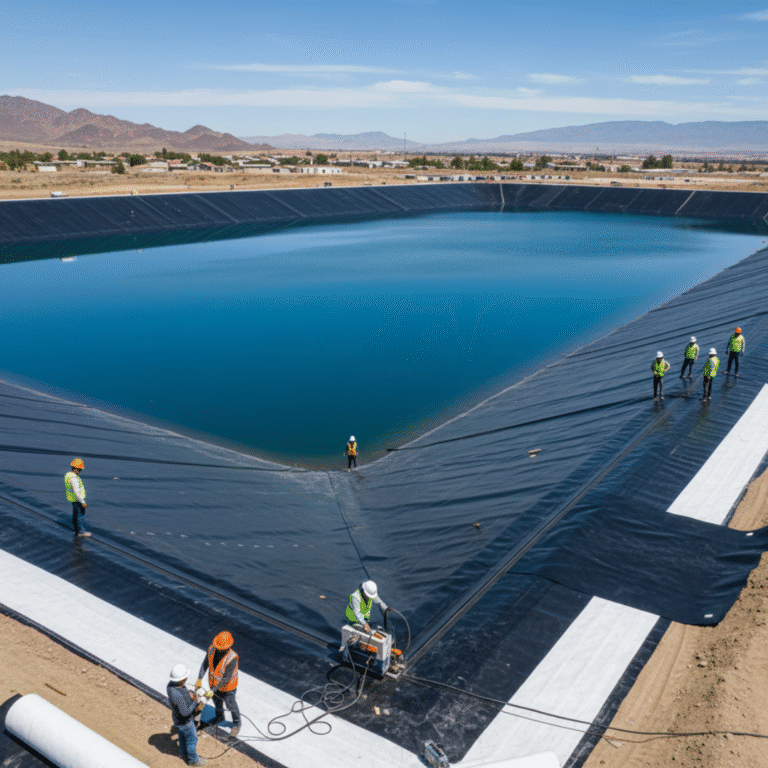
Effluent Lagoons: HDPE geomembrane is extensively used to line large effluent ponds and lagoons, ensuring that harmful chemicals and pollutants do not leach into the soil or groundwater. Its chemical resistance is a key advantage here.
Aeration Ponds & Evaporation Ponds: In regions with high evaporation rates, geomembranes create sealed systems for controlled evaporation, while in aeration ponds, they maintain containment during biological treatment processes. This is a critical environmental protection measure.
2. Mining and Resource Extraction
Pakistan’s mining sector, including coal, copper, and salt, relies heavily on efficient and environmentally responsible practices.
Heap Leach Pads: For gold and copper extraction, geomembrane liners are indispensable for lining heap leach pads, preventing the highly acidic or alkaline lixiviant solutions from contaminating the underlying soil and aquifers. This application demands extremely robust geomembrane thickness (often $2.0 \text{ mm}$ or more) and superior puncture resistance.
Tailings Storage Facilities (TSFs): TSFs, which hold the waste byproducts of mining, are critical containment structures. Geomembranes provide the primary barrier to prevent toxic substances from escaping, ensuring waste management integrity.
3. Oil & Gas Sector
The exploration, production, and refining of oil and gas generate various byproducts and require secure storage.
Frac Ponds: In areas utilizing hydraulic fracturing, geomembrane liners are used for frac ponds to store process water, preventing contamination of local water sources.
Oil Spill Containment: Temporary or permanent geomembrane-lined berms and pits can be quickly deployed for oil spill containment, minimizing environmental damage.
Brine Ponds: Secure containment for highly saline brines is essential to prevent soil degradation.
4. Power Generation
Thermal power plants, a significant component of Pakistan’s energy mix, utilize geomembranes for various water management needs.
Ash Ponds: Coal ash ponds require robust liners to prevent heavy metals and other contaminants from leaching into the environment.
Cooling Water Reservoirs: Geomembranes ensure efficient water containment for cooling water reservoirs, minimizing losses and supporting continuous plant operation.
5. Landfills and Solid Waste Management
As urban populations grow, effective solid waste management becomes a critical challenge.
Municipal Solid Waste (MSW) Landfills: Modern landfills in Pakistan increasingly integrate HDPE geomembrane as a basal liner to collect leachate, a highly contaminated liquid that forms as waste decomposes. This forms a vital part of the environmental barrier system.
Hazardous Waste Landfills: For hazardous industrial waste, multiple layers of geomembranes, often combined with geotextile underlayment, create multi-layered containment systems.
6. Chemical and Petrochemical Industries
These industries handle highly corrosive and toxic substances, making robust containment non-negotiable.
Secondary Containment: Geomembrane liners are used beneath tanks and around processing areas as a secondary containment measure, capturing spills and preventing environmental disasters. Their chemical resistance is paramount here.
Process Ponds: Lining for ponds containing acids, alkalis, or other process chemicals ensures operational safety and environmental integrity.
Selecting the Right Geomembrane for Industrial Use
Choosing the appropriate industrial geomembrane involves several critical considerations:
Material Type: HDPE for its superior chemical resistance and strength; LLDPE for flexibility and ease of installation on challenging terrains.
Geomembrane Thickness: Dependent on hydrostatic pressure, subgrade quality, and the nature of the contained material. For heavy industrial use, $1.5 \text{ mm}$ to $2.5 \text{ mm}$ is common.
Chemical Resistance: Crucial for containing aggressive industrial effluents.
UV Resistance: Essential for long-term outdoor applications in Pakistan’s sunny climate.
Puncture and Tear Resistance: Important for areas with heavy machinery traffic or rough subgrades.
Installation Expertise: Requires specialized welding equipment and experienced technicians for proper seaming and quality assurance. This ensures the geomembrane barrier functions as intended.
Cost-Effectiveness: A balance between initial investment and long-term performance, maintenance, and compliance costs.
Case Studies: Successful Geomembrane Implementations in Pakistan’s Industrial Sector
While specific company names and highly sensitive project details in Pakistan are often proprietary and not publicly disclosed in detail, the successful application of industrial geomembrane applications can be clearly seen across several key sectors, demonstrating adherence to modern engineering practices and environmental compliance. These generalized case studies illustrate how geomembrane technology has been successfully utilized to solve major industrial challenges, ensuring both operational efficiency and environmental protection.

Case Study 1: Large-Scale Water Conservation and Seepage Control
Project Focus: Lining an Irrigation Canal Network/Industrial Reservoir
In Pakistan’s agricultural heartland, particularly Punjab and Sindh, substantial water resources are lost daily due to seepage in unlined irrigation canals or large, unlined industrial cooling water reservoirs. This is a major challenge for water management.
Challenge: A large industrial complex utilizing a nearby canal system for raw water supply or a power plant relying on a massive cooling water reservoir faced significant water loss (up to 30% or more) due to the porous, sandy subgrade. This resulted in high pumping costs and strain on regional water availability.
Solution Implemented: High-quality HDPE geomembrane with a thickness of $1.5 \text{ mm}$ was deployed and anchored in the channel/reservoir bed. A non-woven geotextile underlayment was used beneath the liner to enhance puncture resistance against the coarse subgrade. Specialized hot-wedge welding was used for all seams to create a continuous, impermeable geomembrane barrier.
Outcome: The project achieved over 95% reduction in water seepage, drastically reducing the water replenishment needs and associated energy costs. The enhanced water containment significantly improved the operational reliability of the facility and served as a successful demonstration of responsible water management.
Case Study 2: Hazardous Waste Management in the Mining Sector
Project Focus: Secure Containment for a Mining Tailings Storage Facility (TSF)
The mining industry, particularly for metals and coal, generates substantial volumes of toxic tailings and industrial wastewater requiring safe, long-term containment.
Challenge: A major mining operation needed to expand its tailings storage facility (TSF) in a geologically sensitive area. The primary concern was the extremely corrosive nature of the leachates and the need for maximum environmental protection against groundwater contamination.
Solution Implemented: A double-liner system was specified. The primary liner comprised a textured HDPE geomembrane ($2.0 \text{ mm}$ thickness) for maximum strength and slope stability, followed by a secondary smooth HDPE geomembrane layer. A specialized drainage geocomposite was placed between the layers to facilitate a leak detection and collection system. The robust geomembrane thickness was chosen to withstand the heavy point loads from the solid tailings material.
Outcome: The successful installation of the geomembrane technology provided a certified, high-integrity containment system that met international waste management standards. This not only ensured regulatory compliance in Pakistan but also protected the surrounding ecosystem from the hazards associated with the mining effluent ponds, securing the project’s service life.
Case Study 3: Wastewater Treatment Pond Sealing
Project Focus: Lining an Industrial Effluent Treatment Lagoon
Many manufacturing units in industrial zones are required to implement effective effluent treatment before discharge. Leaking treatment ponds defeat the purpose of the treatment.
Challenge: A large textile or chemical plant’s wastewater treatment facility utilized aeration and settling lagoons, but significant leakage was detected, leading to the contamination of nearby soil and requiring continuous, expensive replenishment of the treatment volume. The effluent contained various harsh chemicals.
Solution Implemented: An LLDPE geomembrane ($1.5 \text{ mm}$ thickness) was selected. While HDPE offers higher chemical resistance, LLDPE’s superior flexibility allowed for easier installation and conformance to the existing, slightly irregular earth basin structure, minimizing wrinkles which can be stress points. The material was confirmed to possess adequate chemical resistance for the specific industrial effluent. An anchor trench was constructed around the perimeter to provide robust structural stability.
Outcome: The project successfully achieved zero seepage from the effluent ponds, allowing the plant to stabilize its biological treatment processes and comply fully with local discharge regulations, marking a significant step towards responsible sustainable industrial growth.
Summary of Success Factors
These case studies highlight the recurring elements that define successful industrial geomembrane applications in Pakistan:
Material Choice: Selecting the correct polymer (HDPE for strength/chemical resistance, LLDPE for flexibility) tailored to the contained substance.
Thickness Specification: Ensuring adequate geomembrane thickness (e.g., $1.5 \text{ mm}$ to $2.0 \text{ mm}$) to handle hydrostatic pressure and high puncture resistance requirements.
Ancillary Protection: Routine use of geotextile underlayment to safeguard the primary geomembrane liner.
Professional Installation: Relying on specialized contractors for high-quality seaming and installation, ensuring the geomembrane barrier is continuous and leak-free for its intended long-term durability.
The Future of Geomembranes in Pakistan
As Pakistan continues its journey of industrialization, the demand for reliable geomembrane solutions will only intensify. With growing awareness of environmental protection and stricter regulatory frameworks, the adoption of advanced geomembrane technology will be instrumental in ensuring sustainable industrial growth, protecting natural resources, and safeguarding public health. Local manufacturers and suppliers are increasingly playing a vital role in providing tailored industrial liners that meet the specific needs of Pakistan’s diverse industrial sectors.
FAQ’S
Where are industrial geomembranes commonly used in Pakistan?
Industrial geomembranes are widely used in chemical plants, wastewater treatment facilities, power plants, mining sites, oil and gas projects, industrial ponds, hazardous waste containment, and manufacturing units. They provide long-term leakage prevention and environmental protection.
What thickness of geomembrane is recommended for industrial applications?
Most industrial applications require 1.5mm to 2.0mm HDPE geomembrane due to high chemical resistance, pressure tolerance, and durability. Heavy-duty applications such as mining and hazardous waste containment may require 2.0mm or thicker.
Are geomembranes resistant to industrial chemicals and waste materials?
Yes. HDPE geomembrane is highly resistant to acids, alkalis, oils, fuels, heavy metals, and industrial effluents, making it ideal for chemical industries, wastewater lagoons, and hazardous waste sites. LDPE is used for lighter industrial needs where flexibility is required.
Do industrial geomembrane installations require specialized welding and testing?
Absolutely. Industrial geomembrane projects use hot wedge welding, extrusion welding, destructive and non-destructive seam testing, and strict QA/QC procedures to ensure perfect sealing. Professional installation is essential for safety and long-term performance.